

Getting four selections right on a five-match accumulator feels close. Your balance records a losing ticket all the same.
That gap between picking winners and winning accumulators is worth tracking. The Nerd Nook, Gambling Nerd’s hub for betting mathematics and strategy, suggests starting with a simple app that records both the complete ticket and the selections inside it.
You can ask ChatGPT or Claude to help build it. Start with fictional tickets, check the calculations yourself, and then use paper bets to practise recording results. The aim is to understand your decisions before putting money behind them.
For readers following Premier League, La Liga, Serie A, Bundesliga, Ligue 1, Champions League or Nigerian Premier Football League fixtures, here is how to put that tracker together.
Step 1: Decide what the app needs to tell you
Start with a question your betting history can answer:
How do my accumulator tickets perform, and what happens to the individual selections inside them?
That gives your app two connected records.
The ticket record holds the stake, combined decimal odds, settlement and net profit or loss.
The selection record holds each match, competition, market, individual price and result. Each selection is usually called a leg.
This structure fits the markets listed on SoloPredict, including double chance, over 1.5 goals, over 2.5 goals and both teams to score. You can use its accumulator page as a starting point for paper records, saving the selections and available prices before kick-off.
Keep the first version manageable. Ordinary pre-match accumulators with separate matches are enough. Cash-outs, free bets and complicated settlement rules can wait.
Step 2: Give the AI a clear building brief
“Build me a betting app” leaves too many decisions to the AI. Specify the records, calculations and limitations.
Copy this prompt into ChatGPT or Claude:
Build a mobile-friendly football accumulator tracker as a single HTML file with embedded CSS and JavaScript.
Use decimal odds and Nigerian naira, with an optional currency setting. The app is for manual recordkeeping and paper betting.
Each ticket needs an ID, date, stake, accepted combined odds, status, actual return and notes.
Each ticket must contain individual legs with a match ID, fixture, competition, market, selection, decimal odds and result. Include Premier League, La Liga, Serie A, Bundesliga, Ligue 1, UEFA Champions League and NPFL options, plus a custom competition field.
Support adding, editing, deleting and settling tickets. Save records in browser local storage. Include JSON backup and restore, and CSV exports for tickets and legs.
Show settled stakes, returns, net profit, ROI, ticket win rate, leg win rate and a cumulative net profit chart. Show comparisons by ticket length, with sample counts.
Keep pending stakes separate from settled performance. Count a ticket’s stake only once, regardless of how many legs it contains.
Flag repeated selections across open tickets and multiple selections from the same match. Do not assume same-match legs are independent or calculate their combined price by multiplying individual odds.
Include a clearly labelled fictional demo dataset and a button to remove it. Explain how to open the file, back up records and verify the calculations. Do not connect to a bookmaker or generate betting recommendations.
Save the generated code as an HTML file and open it in your browser. If anything fails, describe the exact problem to the AI and ask for a corrected version.
A useful bug report is specific: “Editing T2 changes its stake in the ticket list, but the dashboard still shows the old total.”
Step 3: Check the money calculations first
Before improving the design, check the arithmetic.
For a straightforward winning accumulator:
Return = stake × accepted combined decimal odds
Net profit = return − stake
Suppose a fictional ticket contains two selections priced at 1.40 and 1.60. If the accepted combined price is 2.24, a ₦1,000 stake returns ₦2,240 when both win. Its net profit is ₦1,240.
If either leg loses, the ticket returns nothing and its net result is −₦1,000.
The accumulator explanation from The Nerd Nook provides useful background on how multiple selections affect the overall bet. The practical point for your app is that a winning leg does not produce a separate payout inside an ordinary accumulator.
Record the bookmaker’s accepted ticket price rather than relying entirely on a multiplication preview. Special pricing, rounding and related selections can make those figures differ.
For a voided leg, follow the applicable settlement rules. A common treatment is to remove that leg’s price from the accumulator, effectively making it 1.00. Your app should let you confirm the revised return manually.
Step 4: Test the app with fictional tickets
Use a small dataset whose answers you already know.
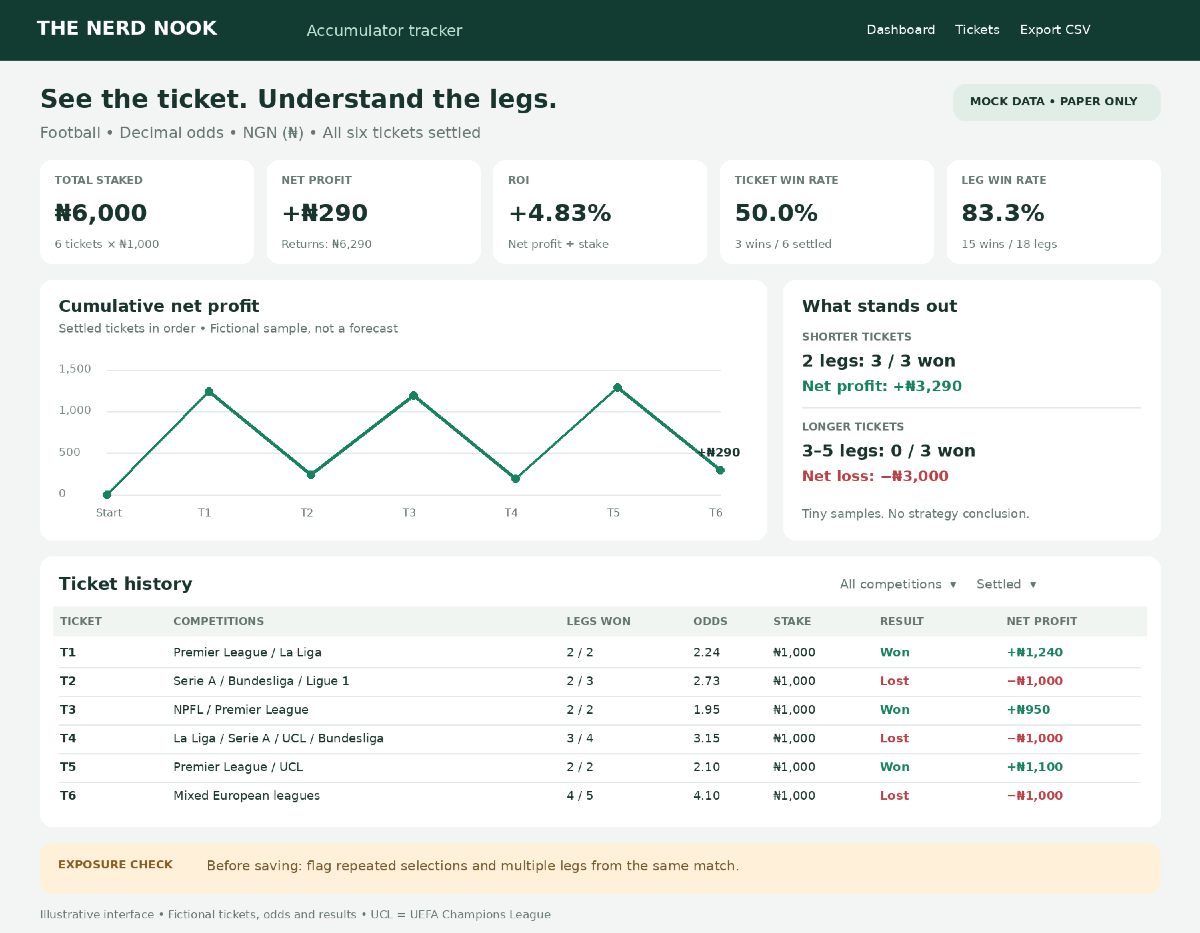
The preview below contains six fictional tickets, each with a ₦1,000 paper stake. Three win at combined odds of 2.24, 1.95 and 2.10. The other three lose.
Those winning tickets return ₦2,240, ₦1,950 and ₦2,100 respectively.
Across all six tickets, the correct totals are:
-
Total staked: ₦6,000.
-
Total returned: ₦6,290.
-
Net profit: ₦290.
-
ROI: approximately 4.83%.
-
Ticket win rate: 50%, or three wins from six tickets.
-
Leg win rate: approximately 83.3%, or 15 successful selections from 18.
ROI is net profit divided by settled stakes, multiplied by 100. It is not total returns divided by stakes.
What the finished app could look like
Illustrative app preview using mock data. The fixtures, prices and results represent a fictional test dataset, not SoloPredict’s performance or a forecast.
The screenshot shows why both win rates matter. Most selections succeeded, but half the tickets still lost.
It also separates two-leg tickets from longer accumulators. In this deliberately small example, the three two-leg tickets make ₦3,290, while the three longer tickets lose ₦3,000. That demonstrates the comparison feature. Six tickets cannot establish which approach will perform better in future.
Step 5: Test the awkward cases
A dashboard can look convincing while quietly counting money twice. Give the AI a short checklist of cases to verify.
A losing ticket with unfinished matches: If one leg has already lost, an ordinary accumulator may be settled as a loss. The remaining leg results should stay pending until their matches finish. Otherwise, the app could record unfinished selections as defeats.
A voided leg: Test a ₦1,000 ticket containing prices of 1.50 and 1.40. If the 1.40 leg is void and the other wins, the return should be ₦1,500 under standard void-leg treatment.
A fully voided ticket: A refunded ₦1,000 stake produces zero net profit. Exclude it from the settled-stake denominator used for ROI, and from ticket win rate.
A pending ticket: Its stake belongs in an “open stakes” figure. It should not appear as a completed loss.
An edited ticket: Changing a stake or correcting a result must update every relevant total and chart.
Also test backup and restore. Export the fictional records, remove them, and restore the backup. The ticket count, legs and totals should match exactly.
Step 6: Add comparisons that explain your results
Once the basic calculations work, add filters that help you inspect the records.
Ticket length
Compare two-leg, three-leg, four-leg and five-or-more-leg accumulators. Show ticket count, settled stakes, net profit and ROI for each group.
A percentage without a sample count is easy to misread. “Two wins from three tickets” tells you more than a large “67%” badge.
Market type
Track double chance, over 1.5, over 2.5, BTTS and other markets separately at leg level.
That can reveal which selections have been succeeding most often. It does not automatically establish profitability: a high success rate at short prices can still lose money.
Avoid giving every winning leg part of the accumulator’s profit. The payout belongs to the ticket as a whole.
Competition
Let users filter individual selections by league or competition. A mixed Premier League and La Liga accumulator should retain both labels.
Keep these leg-level results separate from ticket ROI. Assigning a mixed ticket’s full profit to both leagues would duplicate its contribution.
Repeated exposure
Suppose the same team-to-win selection appears on three ₦1,000 tickets. One disappointing result could defeat all three.
The app should flag that ₦3,000 of ticket stakes depends on the repeated selection. This is a concentration warning, not an extra amount to add to total stakes.
It should also flag multiple selections from one match. BTTS and over 2.5 goals, for example, can be related. Their probabilities cannot simply be treated as independent.
Step 7: Begin a paper-tracking period
After the fictional tests pass, record selections before kick-off without placing bets.
Choose a consistent method, such as recording every accumulator you would normally consider over four weekends. Save the available odds, stake assumption and reason for each selection.
Record the losing tickets as carefully as the winners. Leave abandoned ideas in a separate notes area so they cannot be added retrospectively as successful picks.
Use this period to check whether the app is practical. Can you enter a ticket easily on your phone? Can you find an old selection? Does correcting a result update the chart?
A paper-tracking period tests your process and software. Even 100 tickets would not, by itself, prove a lasting betting advantage.
Step 8: Keep the tracker useful and backed up
A tracker should make your history easier to review. Avoid features that encourage you to chase losses, increase stakes automatically or add another leg to reach a target payout.
Browser storage can disappear when you clear site data or change devices. Export a backup regularly, and keep bookmaker passwords, payment details and account credentials out of the app.
If you later record real wagers, include actual returns and any relevant charges. Keep subscription costs visible separately so the dashboard can show results before and after those expenses.
The most useful review may be a simple one: “I kept repeating the same selection across several tickets,” or “My high leg win rate did not translate into profitable accumulators.”
Those are observations a clear record can support. AI can help you build the tool; accurate entries and checked calculations make it worth using.
About The Nerd Nook
Nerd Nook Hub is the math and strategy side of GamblingNerd.com. It covers odds, probability, house edge, betting systems, and data-backed predictions in plain English.