
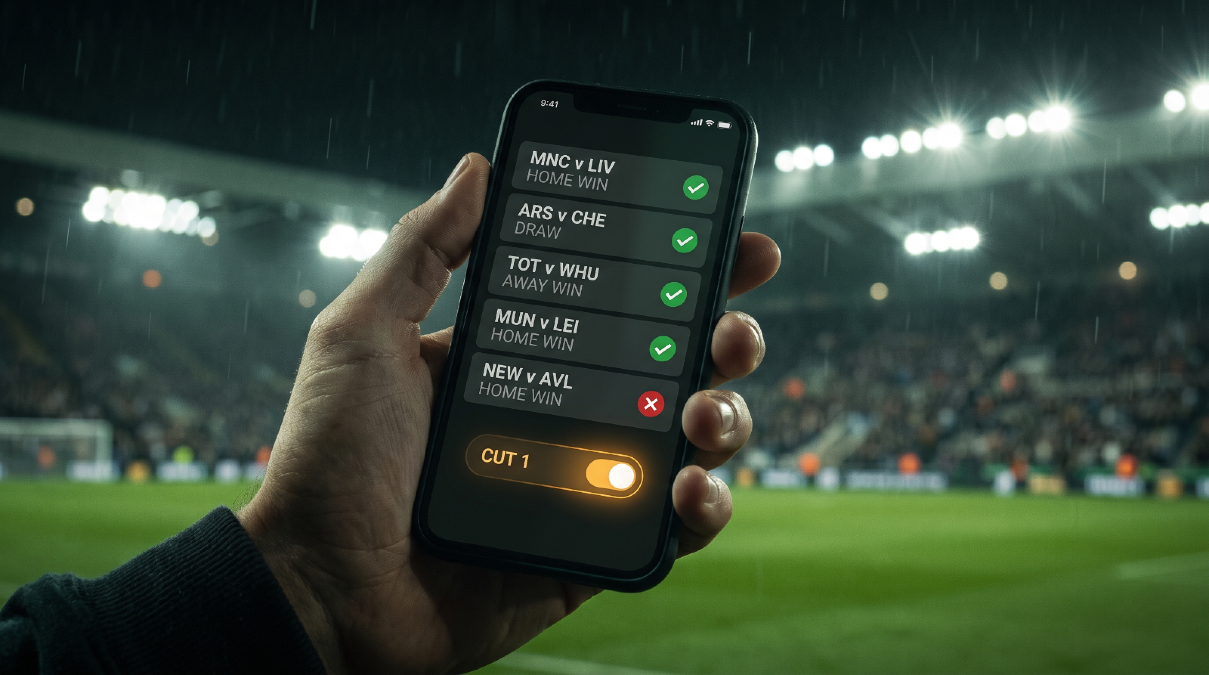
Cut 1 is the most misunderstood button on a Nigerian betslip. Ask ten punters what it does and eight will tell you it refunds your stake when one game cuts. It doesn't. It never has. What it actually does is sell you a smaller, safer version of your own ticket, and the price is quietly taken out of your winnings before the first ball is kicked.
That's not a reason to avoid it. Cut 1 Bet9ja is a genuinely useful feature and on the right kind of ticket it is the difference between collecting something and collecting nothing. But you should know what you're buying. This is the breakdown nobody at the betting shop gives you.
What Cut 1 actually does
Straight from Bet9ja's own help pages: build a multiple with at least five events, tick the Cut 1 box on your betslip, and your odds get recalculated so that the ticket can still pay out if one selection loses. The payout depends on which game cuts. And Bet9ja is upfront in its own terms — by ticking the box, you agree to accept the lower maximum payout shown on the slip.
Read that last line again. Lower maximum payout. Before anything has happened. Before a single game has kicked off.
So the mechanic is not insurance in the way Nigerians usually mean insurance. Nobody hands you your ₦2,000 back. What happens is your five-leg ticket becomes a hybrid: it pays big if all five land, it pays small if four land, and it pays nothing from the second leg that cuts onwards. You've traded some of the top-end for a floor.
Betway runs the same idea but wants six legs minimum. SportyBet has its own version, and other Nigerian books — Betbonanza, ZEbet, 1xBet — all offer a flavour of it. The names change, the leg requirement changes, the underlying trade never does. You give up ceiling, you buy a floor.
The number you should be staring at
Here's the honest way to price it, and it takes ten seconds.
Build your ticket normally. Note the potential winnings. Now tick Cut 1 and note the new potential winnings. The gap between those two figures is your premium. That's the money you're paying, on every ticket, including the ones where all five legs win comfortably and you never needed the cover at all.
Say you've got five picks at 1.80 each. Full odds come to about 18.90, so ₦1,000 returns roughly ₦18,900 if everything lands. Tick Cut 1 and that number drops. However far it drops is exactly what the feature costs you. If it falls to ₦14,000, you've handed over about ₦4,900 of upside in exchange for the four-out-of-five safety net.
Was that worth it? Depends entirely on how often four of your five legs land versus five. And most punters have never once sat down to work that out, which is the real problem here. They tick the box because it feels safer, and feeling safer is not a strategy.
If you want to see what a disciplined five-leg ticket even looks like before you start pricing insurance on it, our 5 fold accumulator tips page is built around that exact leg count, which happens to be the minimum Cut 1 needs.
When Cut 1 is worth the money
There is a narrow band where this feature earns its keep, and it's narrower than the marketing suggests.
Your legs are short and genuinely solid. Five selections in the 1.40 to 1.80 range, each one researched, each one a side you'd back on its own. On that kind of ticket, four-from-five is a common outcome. The one banana skin gets covered and you still collect. This is Cut 1 working as designed. Start from something like our sure banker of the day picks and you're in the right neighbourhood.
You have one leg you're not fully sure about. Four bankers and a coin flip. Cut 1 means the coin flip stops being a ticket killer. It becomes a bonus if it lands. Honestly this is the single best use case, because you're using the feature to buy permission to include one speculative pick instead of dropping it entirely or letting it sink four good calls with it.
The premium is small relative to what you're covering. Some tickets barely move when you tick the box. Others get gutted. Check every time. The reduction is calculated off the odds in your specific multiple, so there's no fixed percentage to memorise. If the drop looks brutal, don't tick it.
When Cut 1 is a trap
Long-odds tickets are where most Nigerian punters get this wrong. You load up eight legs at 2.50 and above, tick Cut 1, and feel protected. You are not protected. On a ticket like that, two legs cutting is the normal outcome, not the unlucky one, and Cut 1 covers exactly one. So you've paid a premium for cover that almost never triggers in your favour. If you're chasing that kind of return anyway, go in with clear eyes and read our 20 odds prediction page first. High odds tickets are a different game with different rules and insurance isn't what fixes them.
Correlated legs are the quieter version of the same mistake. If your five picks are all overs in the same league on the same day, or all home wins on a weekend where the away sides happen to be travelling badly, they aren't five independent bets. They're one bet wearing five hats. When that theme fails it fails across the whole ticket, and Cut 1 saves you from precisely nothing.
And if you're ticking the box because you're down for the week and this ticket has to land, the feature isn't the issue. Take the day off.
Cut 1 versus just betting a smaller acca
Here's the question almost nobody asks: instead of five legs with Cut 1, why not just bet four legs without it?
It's a fair challenge and the answer is subtle. Four legs with no insurance pays full odds on four correct — no reduction, no premium. Five legs with Cut 1 pays reduced odds on five correct, and something smaller on four correct. The five-leg version gives you a shot at the bigger number while keeping a floor. The four-leg version gives you clean pricing but a hard ceiling.
Which is better depends on whether that fifth pick is any good. If it's a genuine 60% call, adding it with Cut 1 makes sense. If you're padding the ticket to reach the five-leg minimum so you can tick a box, you've engineered the whole thing backwards and you'd be better off with four clean legs.
That's the test. Would you back leg five on its own? If no, it shouldn't be on the ticket, Cut 1 or not.
The bookmaker-by-bookmaker reality
Bet9ja wants five legs minimum, works on any sports multiple, and won't interfere with the multiple boost, though it can't be stacked with sports bonuses. The betslip shows the reduced payout before you confirm, which is the most transparent implementation of the three. Credit where it's due. Our Bet9ja prediction today page is set up with their markets in mind.
SportyBet runs its own cut one variant. Terms shift, so read what's on your slip rather than what a blog told you six months ago. SportyBet prediction today covers the fixtures side. BetKing is similar territory and the advice is the same: check the slip. BetKing prediction today if that's your book.
The pattern across all of them is that the operator will always show you the adjusted figure before you commit. Nobody is hiding it. The reason punters feel cheated afterwards is that they never looked.
Building a ticket that Cut 1 can actually rescue
If you're going to use this feature properly, build for it deliberately.
Start with three picks you'd bet individually. Not "probably fine" — actually bet. Add a fourth from a market with tighter variance, something like the unders markets where you're betting on a game not exploding rather than on a specific side performing. Our under 2.5 goals predictions page is useful for exactly this slot. Then, and only then, add your fifth speculative leg and tick Cut 1.
That's a ticket where the insurance has a real job. Four legs are load-bearing, one is the swing, and the feature covers the swing. Compare it to the standard approach, which is five picks chosen because the odds looked nice together and Cut 1 ticked at the end as an afterthought. Same button. Completely different expected value.
If you'd rather have the shape of the ticket handed to you, our accumulator of the day is put together with this structure in mind and updated every morning.
A word on how we call these
Cut 1 shifts your distribution of outcomes. It does not improve your picks, and the picks are still the whole game.
If you want to see how we arrive at ours, how we predict lays out the method and prediction results shows what actually landed rather than what we claim landed. That second link matters more than the first. Any site can describe a methodology.
FAQ
What does Cut 1 mean on Bet9ja?
Cut 1 lets an accumulator of five or more legs still pay out when exactly one selection loses. Your odds are recalculated when you tick it, so the maximum payout shown drops before the games even start. If two or more legs cut, the ticket is dead like any other multiple.
Does Cut 1 refund my stake?
No. This is the most common misunderstanding in Nigerian betting. Cut 1 is not a stake refund and not a free bet. It recalculates your ticket so a four-from-five outcome returns something instead of nothing, and you pay for that by accepting lower odds across the board.
How many games do I need for Cut 1?
Bet9ja requires at least five events. Betway asks for six. Other Nigerian books set their own minimums, so check your betslip rather than assuming. Five is the common floor, which is why five-leg accas are the natural home for the feature.
Is Cut 1 worth it on high odds tickets?
Usually not. Cut 1 covers one losing leg. On a ticket built from long-odds selections, multiple legs cutting is the expected result, so you're paying a premium for protection that rarely activates. It works best on short-odds accas where four-from-five is genuinely likely.
Can I use Cut 1 with a bonus?
On Bet9ja, no — the feature can't be combined with sports bonuses, though it doesn't affect the multiple boost. Other operators vary. The betslip will tell you when there's a conflict.
Which Nigerian bookmakers offer cut one?
Bet9ja, SportyBet, BetKing, Betway, Betbonanza, ZEbet and several others all run some version of it. Terms differ on leg counts and payout calculation. We track fixtures across all of them — see best prediction site in Nigeria for how we compare.
Cut 1 is a tool, not a rescue. It works when your ticket was already close to decent and one leg was always going to be a gamble. It does nothing for a ticket that was never any good. Look at the payout difference on the slip before you tick, decide whether that number buys you enough, and move on.
Free predictions are updated on SoloPredict every morning. Build the ticket first, price the insurance second.